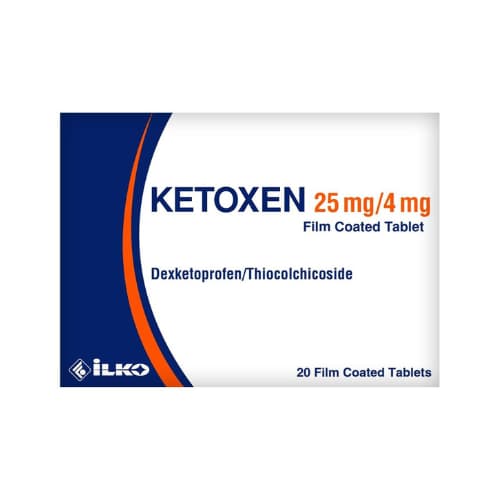
Non-steroidal anti-inflammatory medicament.
For oral use.
Active ingredients: each tablet contains 36.90 mg dexketoprofen trometamol (equivalent to 25 mg dexketoprofen) and 4 mg thiocolchicoside.
Excipients: microcrystalline cellulose PH101, colloidal silicon dioxide, magnesium stearate, iron oxide yellow, microcrystalline cellulose PH102, titanium dioxide, sodium starch glycolate, pregelatinized starch, macrogol, polyvinyl alcohol, glyceryl distearate, talc.
What is Ketoxen and what is it used for?
Dexketoprofen, which Ketoxen contains, is a pain reliever belonging to the group of medicines called non-steroidal anti-inflammatory drugs (NSAIDs).
Thiocolchicoside, which Ketoxen contains, mainly has a muscle relaxant effect. It is used for the symptomatic treatment of painful muscle spasms.
Ketoxen is indicated for the symptomatic treatment of osteoarthritis, painful syndromes of the spine (vertebral column), extra-articular rheumatism and painful muscle spasms, post-traumatic and postoperative pain.
Cardiovascular risks:
NSAIDs may cause an increased risk of cardiovascular thrombotic events, myocardial infarction (MI) and stroke, which may be fatal. This risk may increase with longer duration of use. Patients with cardiovascular disease or risk factors for cardiovascular disease may be at greater risk. Ketoxen is contraindicated for perioperative pain management in coronary artery bypass graft (CABG) surgery.
Gastrointestinal risks:
NSAIDs cause serious gastrointestinal adverse effects, which may be fatal, such as bleeding, ulceration and perforation of the stomach or intestines. These events may occur at any time with or without warning symptoms. Elderly patients are at higher risk of serious gastrointestinal (GI) events.
Do not take Ketoxen:
• if you are allergic to dexketoprofen, thiocolchicoside or any of the other ingredients of this medicine • if you are allergic to acetylsalicylic acid or other NSAIDs • if you have asthma or have had asthma attacks, acute allergic rhinitis (short-term inflammation of the nasal mucosa), nasal polyps (growths inside the nose due to allergy), urticaria (skin rash), swelling of the face and throat due to allergy after taking acetylsalicylic acid or other NSAIDs (swelling of the face, eyes, lips or tongue, or difficulty breathing) or wheezing in the chest • if you have a peptic ulcer, stomach or intestinal bleeding or ongoing digestive disorders (e.g., indigestion, heartburn), or if you have had them in the past • if you have had stomach or intestinal bleeding or perforation in the past due to previous NSAID use for pain • if you have ongoing inflammatory bowel disease (Crohn’s disease or ulcerative colitis) • if you suffer from severe heart failure, moderate or severe kidney problems or severe liver problems • if you have increased bleeding tendency or blood clotting disorder • if you suffer from muscle or muscular dysfunction (inability to contract) • if you are pregnant or breastfeeding • in case of coronary artery bypass graft (CABG) surgery and if you need perioperative analgesic therapy • Ketoxen should not be used in children under 18 years of age.
Use Ketoxen with caution in the following cases:
• if you have epilepsy or are at risk of epileptic seizures • if you have diarrhea during treatment • if you have allergies or have had allergic problems in the past• if you suffer from kidney, liver or heart problems (hypertension and/or heart failure), as well as fluid retention, or have had any of these problems in the past• if you are taking diuretics or have very poor hydration and reduced blood volume due to excessive fluid loss (e.g., excessive urination, diarrhea or vomiting) • if you have heart problems, have had a stroke or think you may be at risk of these conditions (e.g., if you have high blood pressure, diabetes or high cholesterol or if you smoke), you should discuss your treatment with your doctor or pharmacist; medicines such as Ketoxen may be associated with a small increased risk of serious cardiovascular diseases such as heart attack (“myocardial infarction”) or stroke. These serious conditions may develop without any warning signs. Inform your doctor if you have any signs and symptoms such as chest pain, shortness of breath, slurred speech, fatigue. Any risk is more likely with high doses and prolonged treatment. Do not exceed the recommended dose or duration of treatment • if you are elderly: side effects may occur more often, especially bleeding and perforation from peptic ulcers, which may be life-threatening. If any of these occur, consult your doctor immediately • if you are a woman with fertility problems (Ketoxen may impair fertility, therefore you should not take it if you are planning to become pregnant or undergoing fertility tests) • if you have a disorder of blood or blood cell formation• if you have systemic lupus erythematosus (a disease characterized by generalized skin peeling) or mixed connective tissue disease (immune system disorders that may affect connective tissue) • if you have had chronic inflammatory bowel disease in the past (ulcerative colitis, Crohn’s disease) • if you have or have had other stomach or intestinal problems in the past • if you are taking other medicines that increase the risk of peptic ulcer or bleeding, e.g., oral steroids, some antidepressants (SSRI type, e.g., selective serotonin reuptake inhibitors), medicines that prevent blood clotting such as aspirin or anticoagulants such as warfarin. In such cases, consult your doctor before taking Ketoxen. Your doctor may want you to take an additional medicine to protect your stomach (e.g., misoprostol or medicines that block stomach acid production).• if you have indigestion or a burning sensation in the chest, abdominal pain or other abnormal abdominal symptoms, stop taking the medicine and consult your doctor.
• As with other NSAIDs, Ketoxen may cause severe gastrointestinal discomfort and, rarely, serious gastrointestinal side effects such as ulcers (sores) and bleeding, which may lead to hospitalization or death. If you experience any of the following during treatment, stop taking the medicine and seek immediate medical attention: blood in the stool, black tarry stools, vomiting blood or material that looks like coffee grounds, dark-colored particles.
• If you have any signs and symptoms of hepatotoxicity (liver poisoning) such as nausea, weakness, fatigue, jaundice, itching, tenderness in the upper right abdomen, flu-like symptoms, stop treatment and seek medical attention immediately.
• Inform your doctor about unexplained weight gain or swelling (edema).
• As with other NSAIDs, Ketoxen may cause serious skin reactions such as exfoliative dermatitis, Stevens-Johnson syndrome (inflammation around the skin and eyes accompanied by bloody blisters, swelling and redness) and toxic epidermal necrolysis (a serious condition with fluid-filled blisters on the skin), which may lead to hospitalization or death.
These serious skin reactions may also occur without any symptoms. If any symptoms such as itching, fever, redness, blistering occur, stop using the medicine and inform your doctor as soon as possible.
If any of the above applies to you, or has applied to you in the past, please consult your doctor.
Ketoxen with food and drink: take the tablets with food, as this helps reduce the risk of stomach or intestinal side effects.
Pregnancy: consult your doctor or pharmacist before taking this medicine. Do not take Ketoxen if you are pregnant.
If you notice that you are pregnant during treatment, consult your doctor or pharmacist immediately.
Breastfeeding: consult your doctor or pharmacist before taking this medicine. Do not take Ketoxen if you are breastfeeding.
Driving and using machines:
Ketoxen may slightly affect your ability to drive and use machines, as it may cause dizziness, drowsiness, relaxation or numbness as side effects. If you notice such effects, do not drive or use machines until the symptoms disappear. Consult your doctor for advice.
Important information about some of the ingredients of Ketoxen:
Taking with other medicines:
Inform your doctor or pharmacist if you are taking any of the medicines listed below.
Undesirable combinations:
• Taking Ketoxen together with other medicines that have muscle relaxant effects on the musculoskeletal system is not recommended, as they may increase each other's effect. For the same reason, caution is required due to the increased frequency of adverse effects when used simultaneously with other medicines acting on smooth muscles.
• Acetylsalicylic acid (aspirin), corticosteroids or other anti-inflammatory medicines (medicines used to treat inflammation),
• Warfarin, heparin or other medicines used to prevent blood clots,
• Lithium, used to treat certain mood disorders,
• Rheumatoid arthritis (a chronic disease causing joint pain and deformity) and methotrexate used to treat cancer,
• Hydantoins and phenytoin, used for epilepsy,
• Sulfamethoxazole, used for bacterial infections (microbial diseases causing inflammation).
Combinations requiring precautions:
• ACE inhibitors, diuretics, beta-blockers and angiotensin II antagonists used for high blood pressure and heart problems,
• Pentoxifylline and oxpentifylline used for the treatment of chronic venous ulcers,
• Zidovudine, used to treat viral infections,
• Chlorpropamide and glibenclamide, used for diabetes.
Combinations requiring caution:
• Quinolone antibiotics (e.g., ciprofloxacin, levofloxacin) used for bacterial infections,
• Cyclosporine or tacrolimus used in immune system diseases and organ transplantation,
• Streptokinase and other thrombolytic or fibrinolytic medicines, i.e., medicines used to dissolve blood clots,
• Probenecid used for gout,
• Digoxin used to treat chronic heart failure,
• Mifepristone used as an abortifacient (to terminate pregnancy),
• Selective serotonin reuptake inhibitor (SSRI) antidepressants,
• Antiplatelet agents used to reduce platelet aggregation (blood clot formation) and the formation of blood clots.
How to take Ketoxen?
Always take Ketoxen exactly as your doctor has told you. Ask your doctor or pharmacist if you are not sure.
Your doctor will tell you how long the treatment with Ketoxen will last. Do not stop treatment early, as you may not achieve the desired result.
Method of administration:
Different age groups:
Special conditions of use:
If you take more Ketoxen than you should: consult your doctor or pharmacist.
If you forget to take Ketoxen: take the next dose at the usual time. Inform your doctor if you have missed more than one dose. Do not take a double dose to make up for forgotten doses.
If you stop taking Ketoxen: consult your doctor or pharmacist if you have any problems with using Ketoxen. You may stop using Ketoxen with your doctor’s agreement.
Possible side effects:
If you experience any of the following, stop taking Ketoxen and inform your doctor immediately or go to the nearest emergency department:
Very serious side effects:
• swelling of the hands, feet, ankles, face, lips, or swelling of the mouth or throat causing difficulty in swallowing or breathing • very severe allergic reaction (anaphylactic reaction) • itching, swelling of the skin and mucous membranes (angioedema) • open sores on the skin, mouth, eyes and genitals (Stevens-Johnson and Lyell syndromes) • unconsciousness (vasovagal syncope), fainting • perforation or bleeding of a peptic ulcer, manifested by vomiting blood or black stools • difficulty breathing due to narrowing of the airways (bronchospasm) • shortness of breath • swelling of the larynx (laryngeal edema) • palpitations.
Serious side effects:
If you experience any of the following, inform your doctor immediately or go to the nearest emergency department:
• peptic ulcer • high blood pressure • low blood pressure • very slow breathing • temporary confusion, loss of consciousness • abnormal liver function tests (blood test) • rapid heartbeat • inflammation of the pancreas • liver cell damage • inflammation of the liver (hepatitis) • kidney problems • low white blood cell count (neutropenia), low platelet count (thrombocytopenia) • dizziness • prostate problems,
• kidney failure.
Serious side effects occur very rarely.
Mild side effects:
• nausea and/or vomiting • abdominal pain • diarrhea • digestive problems (indigestion) • mild dizziness • drowsiness • sleep disturbances • irritability • headache • flushing • stomach pain, stomach problems • constipation • dry mouth • bloating • fatigue • pain • feeling of fever and chills • general weakness, feeling weak • fluid retention and swelling of parts of the body away from the trunk (e.g., swelling of the ankles)
• loss of appetite (anorexia) • abnormalities of sensory organs • itchy rash • skin rash • acne • increased sweating • back pain • frequent urination • menstrual disorders • blurred vision • ringing in the ears (tinnitus) • skin sensitivity • sensitivity to light • itching.
Inform your doctor immediately if you notice any gastrointestinal side effects (e.g., stomach pain, heartburn or bleeding) at the beginning of the treatment, if you have previously suffered from such side effects due to long-term use of anti-inflammatory medicines and especially if you are elderly.
Stop using Ketoxen as soon as you notice the appearance of a skin rash or any lesions inside the mouth or on the genitals, or any sign of allergy. During treatment with NSAIDs, fluid retention and swelling (especially in the ankles and legs), increased blood pressure and heart failure have been reported.
Medicines such as Ketoxen may be associated with a small increased risk of heart attack (“myocardial infarction”) or stroke.
In patients with immune system disorders affecting connective tissue (systemic lupus erythematosus or mixed connective tissue disease), anti-inflammatory medicines may rarely cause fever, headache and stiffness of the neck muscles.
If you experience any side effect not listed in this leaflet, inform your doctor or pharmacist.
Storage conditions:
Dispensing conditions: pharmaceutical product group II, dispensed with prescription form No. 3
Marketing authorization holder:
İlko İlaç San. ve Tic. A.Ş.
Veysel Karani Mah., Çolakoğlu Sok.,
No: 10, 34885, Sancaktepe/Istanbul, Turkey
Manufacturer:
İlko İlaç San. ve Tic. A.Ş.
3rd Organized Industrial Zone, Büyük Kayacık Mah.,
Kuddusi Cad., 23rd Sok., No: 1,
Selçuklu/Konya/Turkey