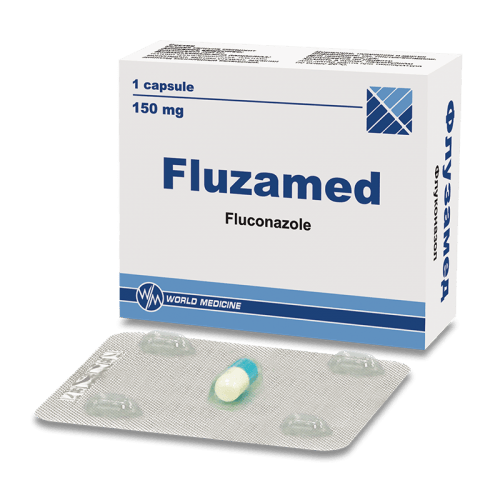
It is used to treat candidal balanitis when local treatment has been unsuccessful.
Each capsule contains:
Active substance: Fluconazole 150 mg.
Excipients: Microcrystalline cellulose, lactose monohydrate, magnesium stearate, sodium lauryl sulfate; capsule shell: black iron oxide, titanium dioxide, yellow iron oxide, gelatin.
Rofluzol is indicated for the treatment of the following conditions in adults:
Treatment may be initiated before the results of culture and other laboratory investigations are available. Once the results are available, appropriate adjustment of antifungal therapy may be necessary.
Official guidelines on the appropriate use of antifungal agents should be taken into consideration.
Adults:
150 mg as a single dose.
Elderly patients:
In the absence of renal impairment, the usual recommended doses should be used.
Renal impairment:
Fluconazole is predominantly excreted unchanged in the urine. No dose adjustment is necessary for single-dose administration.
Hepatic impairment:
Data on patients with hepatic impairment are limited; therefore, caution should be exercised when administering fluconazole to patients with impaired liver function.
Children:
The safety and efficacy of fluconazole for the treatment of genital candidiasis in children have not been established. Currently available data for other paediatric indications are described in the section “Undesirable Effects.” In adolescents (12 to 17 years of age) requiring treatment for genital candidiasis, the same dosage as for adults should be used.
The capsules should be taken orally and swallowed whole, with or without food.
The physician should prescribe the appropriate pharmaceutical form and dosage based on the patient's age, body weight, and the dose required for treatment. The capsules are not intended for use in infants and younger children. More suitable liquid formulations of fluconazole are available for use in these patient groups.
Hypersensitivity to the active substance, other azole compounds, or any of the excipients;
Concomitant use of terfenadine in patients receiving multiple doses of fluconazole at 400 mg per day or higher;
Concomitant use of other medicinal products known to prolong the QT interval and metabolized by the cytochrome P450 (CYP) 3A4 enzyme, such as cisapride, astemizole, pimozide, quinidine, and erythromycin.
Before initiating treatment with fluconazole, the patient should be informed of the potential risk to the fetus.
After treatment with a single dose, a one-week washout period is recommended before attempting pregnancy (corresponding to 5–6 half-lives).
During longer courses of treatment, women of childbearing potential should use contraception throughout the treatment period and for one week after the last dose.
Observational studies indicate an increased risk of spontaneous abortion in women who received fluconazole during the first and/or second trimester of pregnancy compared with women who did not receive fluconazole or who received topical azoles during the same period.
Studies involving several thousand pregnant women who received a cumulative dose of ≤150 mg of fluconazole during the first trimester did not demonstrate an increased overall risk of fetal malformations.
In one large-scale observational cohort study, oral use of fluconazole during the first trimester of pregnancy was associated with a slightly increased risk of musculoskeletal malformations. This corresponded to approximately 1 additional case per 1,000 women receiving a cumulative fluconazole dose of ≤450 mg, compared with women using topical azole preparations, and approximately 4 additional cases per 1,000 women receiving a cumulative dose greater than 450 mg.
The adjusted relative risk was 1.29 (95% confidence interval 1.05–1.58) for an oral fluconazole dose of 150 mg and 1.98 (95% confidence interval 1.23–3.17) for a fluconazole dose greater than 450 mg.
Epidemiological studies of cardiac malformations associated with fluconazole use during pregnancy have shown conflicting results. However, a meta-analysis of five observational studies involving several thousand pregnant women who received fluconazole during the first trimester demonstrated an approximately 1.8- to 2-fold increased risk of cardiac malformations compared with no fluconazole use and/or the use of topical azoles.
Case reports have described a pattern of congenital malformations in infants whose mothers had received high-dose fluconazole (400–800 mg daily) for three or more months for the treatment of coccidioidomycosis. The congenital defects observed in these infants included brachycephaly, ear dysplasia, excessive enlargement of the anterior fontanelle, femoral bowing, and radiohumeral synostosis. A causal relationship between fluconazole use and these congenital malformations remains uncertain.
Animal studies have demonstrated reproductive toxicity.
When planning pregnancy, following a single dose of fluconazole or discontinuation of a course of fluconazole treatment, a washout period of approximately one week is recommended (corresponding to 5–6 half-lives of the medicinal product).
Fluconazole at standard doses and for short-term treatment should not be used during pregnancy unless the expected benefit clearly outweighs the risk.
Fluconazole at high doses and/or for prolonged treatment should not be used during pregnancy except for the treatment of potentially life-threatening infections.
Fluconazole passes into breast milk, where concentrations similar to those in plasma are achieved.
Breastfeeding may be continued after a single standard dose of 150 mg of fluconazole.
Breastfeeding is not recommended during treatment with multiple or high doses of fluconazole.
The benefits of breastfeeding for the infant's development and health should be considered together with the mother's clinical need for the medicinal product and any potentially adverse effects of the medicinal product or the mother's underlying condition on the breastfed infant.
Fluconazole had no effect on the fertility of male or female rats.
No studies have been conducted to assess the effects of fluconazole on the ability to drive or operate machinery.
Patients should be warned of the possibility of dizziness or seizures during treatment with Rofluzol and advised to refrain from driving or operating machinery if such symptoms occur.
Store at a temperature not exceeding 25°C.
Keep out of the reach of children.