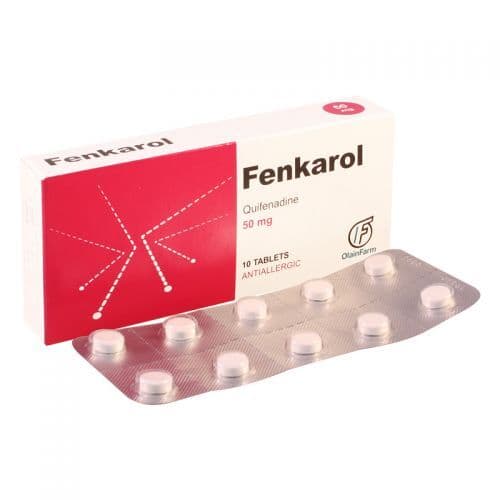
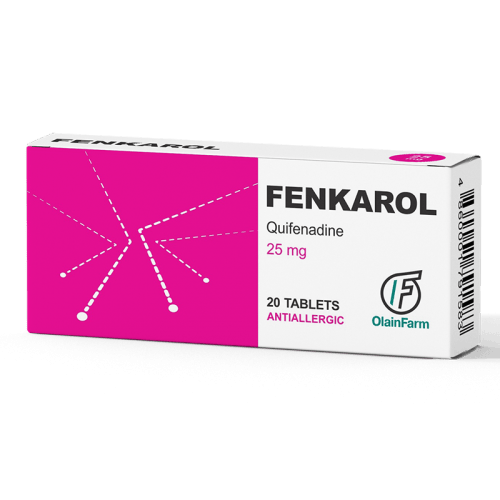
Fenkarol 10 mg – antiallergic tablets with less sedative effect. 20 tablets per pack.
Quifenadine
Fenkarol
International Nonproprietary Name: Quifenadine.
Main physical and chemical properties:
Fenkarol 10 mg: round, white or off-white tablets with a flat surface, scored and with a break line on one side.
Fenkarol 25 mg: round, white or off-white tablets with a flat surface and a score line.
Fenkarol 50 mg: round, white or off-white tablets with a flat surface and a score line.
Each tablet contains quifenadine hydrochloride – 10 mg, 25 mg, or 50 mg.
Fenkarol 10 or 25 mg: excipients – sugar, potato starch, calcium stearate.
Fenkarol 50 mg: excipients – sugar, potato starch, modified corn starch, calcium stearate.
Other antihistamines for systemic use.
ATC code: R06AX31.
The medicine is taken orally immediately after meals.
Fenkarol 10 mg:
For children aged 2 to 3 years, the dose is 5 mg (half a tablet) 2–3 times daily; for children aged 3 to 7 years, 10 mg twice daily; for children aged 7 to 12 years, 10–15 mg 2–3 times daily.
For children over 12 years of age, 25 mg 2–3 times daily. The recommended daily dose may be divided into 4 administrations.
The treatment course is 10–15 days. The course may be repeated if necessary.
Fenkarol 25 mg or 50 mg:
For adults, the dose is 25–50 mg 2–4 times daily. The maximum daily dose is 200 mg.
For children over 12 years of age, 25 mg 2–3 times daily.
The treatment course is 10–20 days. The course may be repeated if necessary.
Fenkarol should not be used in children under 2 years of age.
Fenkarol 10 mg tablets are used in children aged 2 to 12 years.
If a scheduled dose is missed, it should be taken as soon as remembered. However, if it is almost time for the next dose, the missed dose should be skipped.
Like all medicines, Fenkarol may cause adverse effects, although not everyone experiences them.
Adverse effects are classified according to frequency:
Nervous system: uncommon – headache, drowsiness.
Gastrointestinal tract: common – dry mouth; uncommon – digestive disorders (nausea, vomiting), which disappear when the dose is reduced or the medicine is discontinued.
If an adverse effect occurs that is not mentioned in the package leaflet, the patient should consult their treating physician.